
Greek Honey · Heritage · Beekeeping

All About Greek Honey: From the Hive to the Mediterranean Table

Honey is one of nature's most extraordinary foods. Discover how bees create it, what makes each variety different, how to recognize quality and why Greek honey has been treasured for centuries.

Nature's golden expression

A product shaped by flowers, forests, bees and place

Honey begins with the landscape. Bees collect nectar from flowers or gather naturally occurring secretions associated with particular plants and trees, transforming these raw materials inside the hive into one of nature's most complex sweet foods.

Its aroma, color, sweetness and texture are influenced by botanical origin, climate, season and geography.

This is why thyme honey does not taste like forest honey, and why orange blossom honey offers a completely different sensory experience from pine honey.

For the ancient Greeks, honey belonged to a world of nourishment, ritual, mythology and the generosity of nature.

Greek Heritage

Honey in ancient Greek culture

Honey occupied an important place in the food culture and mythology of the ancient Mediterranean.

Nectar and ambrosia appear repeatedly in Greek mythology as foods connected with the gods, while bees themselves carried symbolic importance.

Aristaeus, a figure in Greek mythology and son of Apollo and Cyrene, became closely associated with rural arts including beekeeping.

From mythology to everyday life

Beyond mythology, honey was valued as food and used in a variety of preparations throughout antiquity.

Ancient writers also discussed honey in connection with diet and traditional remedies. These historical uses are part of honey's cultural story, although they should not be confused with modern evidence based medical claims.

What remains unchanged is its importance as a product created through the interaction of bees, botanical diversity and landscape.

From nectar to jar

How bees make honey

Honey production is a remarkable biological process that takes place through several stages inside and outside the hive.

01

Collection

Worker bees collect nectar from flowering plants or suitable plant derived secretions and carry them back to the hive.

02

Transformation

Enzymatic activity begins changing the composition of the collected material while it is transported and passed between bees.

03

Dehydration

Bees reduce the water content by circulating air through the hive, gradually concentrating the developing honey.

04

Maturation

Once sufficiently mature, honey is stored in honeycomb cells and sealed with wax until it is ready to be harvested.

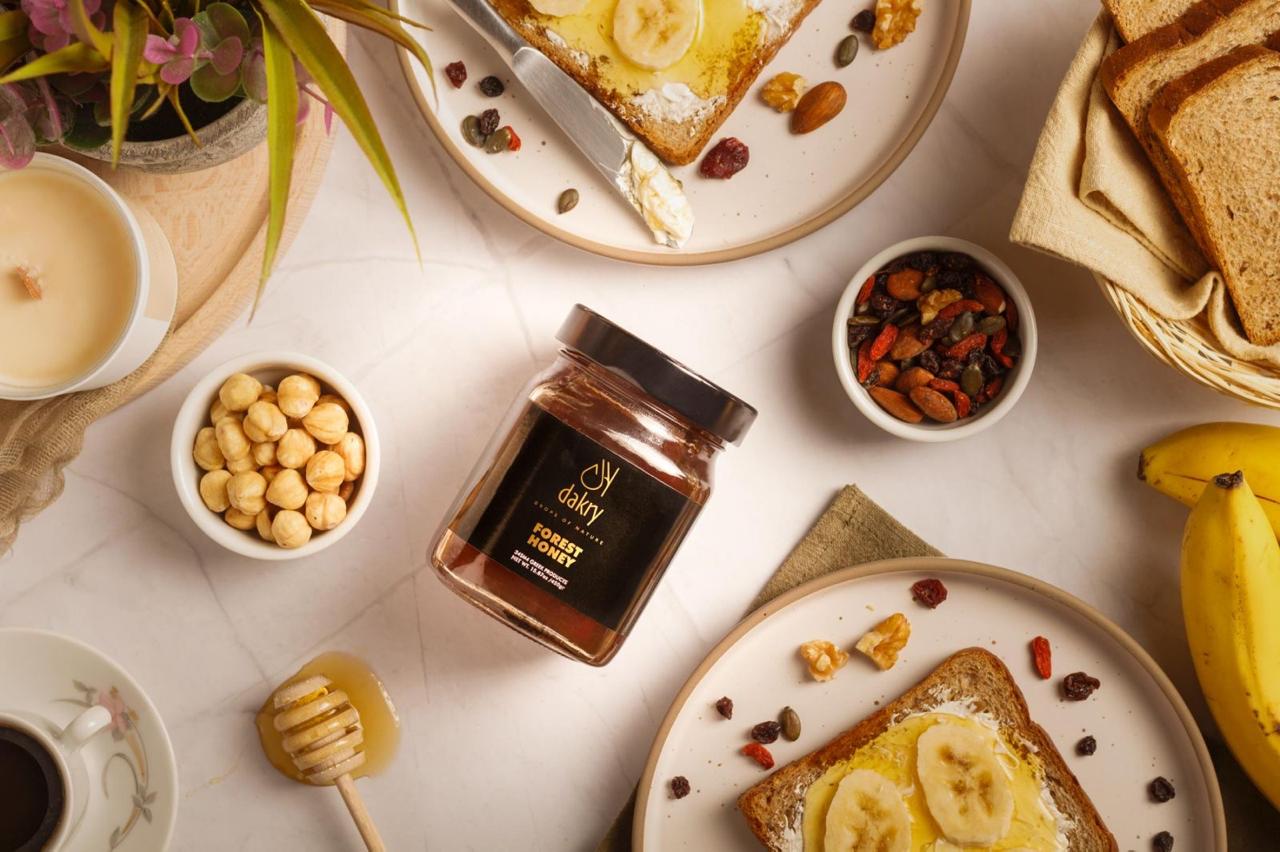
Dakry Greek Forest Honey premium presentation
Greek Forest Honey

Different landscapes create different expressions of honey

Forest honey offers a deeper, more robust character than many floral honeys, demonstrating how strongly botanical origin shapes aroma, color, texture and taste.

Botanical character

Greek honey is not one single flavor

Greece's diverse landscapes allow bees to forage among very different botanical sources, producing honeys with distinct personalities.

01

Thyme Honey

Intensely aromatic with a distinctive Mediterranean herbal character and an amber appearance.

02

Orange Blossom Honey

Floral, bright and delicate, with a characteristic fragrance inspired by citrus blossoms.

03

Forest Honey

Darker and deeper in character, often with woody, malty and less overtly floral notes.

04

Pine Honey

Rich and complex, traditionally associated with Greek pine forests and generally less intensely sweet than many blossom honeys.

05

Flower Honey

A multifloral expression shaped by the mixture of blossoms available to bees during the season.

06

Premium Honey Creations

Dakry also reinterprets Greek honey through refined combinations with ingredients such as Aegina pistachio, walnut and edible 24K gold.

Understanding quality

What should we look for when choosing honey?

Honey quality cannot be judged by one simple visual trick. Botanical origin, moisture, freshness, aroma, composition and proper production all matter.

Botanical origin Knowing whether a honey comes from thyme, orange blossom, forest, pine or multiple flowers helps explain its natural aroma, texture and color.
Origin and traceability Clear information about geographical origin and producer gives consumers a better understanding of the product they are buying.
Aroma and taste Genuine honey should express the sensory characteristics expected from its botanical origin rather than simply tasting generically sweet.
Moisture Excessive moisture can increase the risk of fermentation, which is why water content is an important technical quality parameter.
Natural variation Color and texture vary naturally between honey types. Darker does not automatically mean better, and lighter does not mean lower quality.
Laboratory verification When authenticity or adulteration must be established scientifically, validated analytical testing is far more reliable than household tests.
Myth vs fact

Can a glass of water prove whether honey is pure?

No reliable conclusion about honey authenticity can be reached simply by dropping a spoonful into water and observing how quickly it dissolves.

The behavior of honey in water can change according to viscosity, temperature, moisture content and composition.

If adulteration needs to be established, laboratory analysis is the appropriate method.

A natural transformation

Why does honey crystallize?

Crystallization is a natural physical process that can occur in genuine honey and does not by itself indicate spoilage or adulteration.

The rate of crystallization depends largely on the natural balance between glucose and fructose, as well as storage temperature and the botanical source of the honey.

Some varieties crystallize relatively quickly, while others may remain fluid for much longer.

If you prefer a more liquid texture, place the closed jar in gently warm water and allow it to soften gradually. Avoid boiling or exposing the honey to unnecessarily high temperatures.

Dakry Greek Honey

Discover five landscapes through one extraordinary ingredient

Explore Greek Thyme, Orange Blossom, Forest, Pine and Flower Honey together with Dakry's signature premium honey creations, each expressing a different side of the Greek landscape.

Explore the Honey Collection
Dakry Olive

Nature's golden expression. From Greece.

Estate olive oil

Our extra virgin olive oil comes from our family groves in Methoni, Messinia. Olives are milled within four hours of harvest.

Gold Award · London Olive Oil Competition
Quality Contest 2025

Explore our olive oil

Across borders

Shop online for delivery within the United States. Wholesale and bespoke orders are available across 22 countries by arrangement.

International gifting starts with a conversation. Contact us to discuss your destination.

Enquire about bespoke gifting

Traceable Greek origin

Our extra virgin olive oil is traceable by batch, from our family groves to bottling.

Batch documentation is available on request. Please include the lot number shown on your bottle.

Request batch details